

The digital world is evolving more rapidly than ever before, and businesses with online growth strategies gain significant benefits in the marketplace. A website alone is clearly not enough in 2026. Customers are expecting a unique experience, fast-loading platforms, engaging content, and smooth communication across multiple digital channels. Whether you’re an entrepreneur, a small business owner, or an established enterprise, knowing how to grow your business online is critical to long-term success. In this guide, we will discuss the best ways to help your business attract customers, increase conversions, and build a strong digital presence in 2026. 1. Establish a Strong Digital Foundation Your website is the backbone of your online business. It’s your digital storefront and often creates the first impression on potential customers. To build a strong foundation: A professional and user-friendly website boosts the confidence of customers and also contributes to enhancing the search engine rankings. 2. Give priority to Search Engine Optimization (SEO) SEO is still one of the most powerful and cost-effective ways to attract organic traffic. Search engines will prioritize in 2026: To identify SEO purposes: Businesses that are regularly investing in SEO observe constant increases in traffic, without depending only on paid advertising. 3. Content-Marketing Content marketing enables businesses to build trust and establish authority with their audience. Popular formats are The strategy is not always promoting products but solving customer issues. If you’re in the business of selling fitness gear, create content focused on workout plans, dietary advice, and home gym configurations. This generates potential customers who might buy your products later. Conclusion So how would you grow a business online in 2026? It requires a combination of tech, strategy, and user-friendly execution. Businesses that concentrate on website optimization, SEO, content marketing, social media engagement, the integration of artificial intelligence, and customer experience will be better positioned for long-term success. Digital trends will proceed to evolve, but one thing will stay the same: businesses that provide real value to their customers will win. Use a few of the strategies described in this guide, and you can improve your online presence, win more customers, and grow your business for the long term in an increasingly competitive digital landscape. The future is for those businesses that adapt, innovate, and persevere to invest to build meaningful relationships with their audience.

In today’s competitive market, business growth is not reliant on manpower, capital, or physical expansion. Technology is the most powerful catalyst for effective and sustainable business development. Whether you’re a new business trying to reach your first thousand customers or an established enterprise expanding globally, technology offers the tools you need to grow quicker, be more efficient, and deliver a better customer experience. How To Grow Your Business Scaling a business means increasing your revenue and activities without increasing your costs at the identical rate. Traditional growth means hiring more people, renting greater office spaces, and investing a lot in infrastructure. The equation changes with technology, which allows businesses to do more with less. Automation Removed Operational Bottlenecks Automation is one of the most important benefits of technology. Now, it’s possible to automate repetitive tasks that used to require a lot of time. Businesses Automated: Technology of repetitive manual work allows employees to focus on high-value tasks like innovation, customer engagement, and strategic planning. This results in improved effectiveness, fewer human errors, and reduced operating expenses. For example, an online business can process orders, update inventory levels, and send shipping notifications automatically without the requirement of human intervention all the time. Cloud Computing Provides Flexible Growth Before the cloud expansion, businesses had to invest a lot of funds in servers, hardware, and IT infrastructure. Scaling often paid excessive up-front costs. This model has been altered with cloud computing, which provides access to computing resources on demand. Demand expands, and businesses can instantly scale up storage, processing, or application capacity. The benefits of cloud technology include Flexibility allows the business to develop without the constraints of hardware or expensive upgrades. Making Decisions considering Data Nowadays businesses generate huge quantities of data every day. Technology can help organizations mine this data for actionable insights. Data-Informed Decision Making Nowadays, businesses generate huge quantities of data daily. Technology enables organizations to convert this data into insights that can be acted upon. Tools for advanced analytics can help businesses understand: Instead of establishing assumptions, leaders may base their decisions on real data. This reduces risk and helps businesses find growth opportunities quicker. For example, retailers can analyze customer behavior to figure out which products are the most popular and modify inventory accordingly. Improved Customer Experience Customer expectations are increasing in the digital age. Businesses that provide seamless, personalized experiences typically have an important competitive advantage. Technology enhances customer experience through: Faster customer support

In today’s dynamic world, business success is no longer determined by product or service quality. Technology is the catalyst of innovation, efficiency, customer satisfaction, and long-term growth. From new businesses to multinational corporations, organizations of every kind use business technology to streamline operations, make informed decisions, and stay competitive in an increasingly digital marketplace. Business technology is the set of tools, systems, software, and digital solutions that help organizations run everyday life and achieve strategic goals. Technology has been transforming the way businesses operate and interact with customers, whether it is cloud computing, data analytics, automation, artificial intelligence, or collaboration platforms. Enhancing Operational Efficiency One of the greatest benefits of business technology is improved operational efficiency. Traditional manual processes may be exhausting and costly, as well as increasing the risk of human error. Modern technology can do the things we do over and over again, like enter data, manage inventory, process payroll, and produce reports. Automation opens employees to do higher-value work like creativity, critical thinking, and problem-solving. This helps businesses to increase productivity, reduce operational costs, and improve overall performance. Also, efficient operations allow organizations to respond faster to market changes and customer demands. Making Better Choices with Data In today’s businesses, data has become one of the most valuable assets. Each customer interaction, transaction, and business process generates information that can be examined to yield meaningful insights. Business intelligence and analytics tools help organizations collect, process, and interpret data in real time. With these insights, leaders can identify trends, measure performance, understand customer behavior, and look for future opportunities. Rather than assumptions, businesses may use data to make smarter decisions that reduce risk and boost chances for achievement. Companies that use data well often have a massive advantage ahead of those that don’t. Improving the Customer Experience Customer expectations are increasing with digital experiences becoming standard practice. Consumers want personalized services, fast responses, and seamless interactions across channels from businesses. Technology allows organizations to meet these expectations through customer relationship management (CRM) systems, chatbots, mobile applications, and personalized marketing platforms. These tools allow businesses to understand customer needs and deliver tailored experiences. Innovation and Support over Growth Innovation is essential to business survival and growth. Technology is utilized by organizations to develop new products, improve services, and explore new market opportunities. Cloud computing, artificial intelligence, machine learning, and the Internet of Things (IoT) are generating new possibilities for innovation across industries. Businesses are able to experiment with new ideas, quickly test solutions, and more successfully scale successful initiatives. Technology also removes geographical barriers, allowing companies to enter global markets and serve customers globally. Digital platforms give businesses of any size the chance to compete on a larger scale. Encourage Good Communication and Collaboration With employees working from different locations and time zones, distributed workplaces are more prevalent. Get Ready for the Future The future of business depends increasingly much on technologies. Emerging technologies like AI, automation, blockchain, and advanced analytics will keep creating new opportunities and redefine industries. Conclusion: For businesses, technology is no longer an optional investment, other than the foundation of current success. It improves efficiency, decision-making, customer relations, innovation, and sustainable growth. The digital economy of today demands agility and a competitive advantage, and organizations are looking to technology to remain in front of the competition. As technology continues to evolve, businesses that embrace digital transformation and foster a culture of innovation will be best positioned to ensure long-term success and establish the future of their sector.

The rapid development of evolution in the world of business has never been faster. Customer expectations are changing, competition becomes harder, and technological innovations are affecting industries across the globe. In this changing environment, organizations that utilize digital technology are better able to adapt, grow, and remain competitive. Building a future-ready business is no longer about simply adopting new tools; it’s about building a digital-first mindset that motivates continuous innovation and long-term success. Digital Transformation Knowledge Digital transformation is the use of digital technology to boost business processes and add value to customers. It changes the way businesses operate, create value for customers, and make decisions. More importantly, it allows businesses to reconsider traditional processes and find smarter, more efficient ways of working. A future-ready business uses technology not only to enhance productivity but also to provide better customer experiences, enhance operations, and set up new revenue streams. The way Technology Can Help Your Business Grow Digital innovations are the foundation of modern business growth. Companies can use technology to automate repetitive tasks, evaluate huge quantities of data, and connect with customers across multiple digital channels. For example, cloud computing allows organizations to access resources on demand, which may decrease infrastructure costs and increase scalability. Data analytics helps businesses to understand customer behavior, identify market trends, and make smart decisions. Artificial intelligence enhances efficiency by automating processes and customizing customer interactions. The application of these technologies enables businesses to respond quickly to market changes and maintain their competitive advantage. boost the customer experience. One of the most important factors for a business to be successful is customer experience. Customers today desire convenience, personalization, and instant support. Businesses meet such expectations effectively with the support of digital tech. Businesses utilize Customer Relationship Management (CRM) to track customer interactions and preferences. Customer service chatbots and virtual assistants offer 24/7 assistance, guaranteeing that customer questions are addressed quickly. Data analytics gives businesses the ability to run targeted advertising campaigns, providing individual customers with relevant content and offers. Customers who get seamless personalized experiences are more likely to stay loyal and spread the word to others about the brand. Developing a Digital-First Culture Success in digital transformation is not about technology abuse. It needs a culture that promotes change, innovation, and continuous learning. Conclusion: For success in a more competitive world, it’s essential to develop a future-ready business by utilizing digital technology. Businesses can set themselves on a path for sustainable growth with digital tools, data-driven decision-making, technology, improved customer experiences, and creativity. The future is for those businesses that are ready to evolve, adapt, and innovate regularly. Digital technology is not a tool; it works. It is a strategic enabler that allows organizations to be competitive and successful in the business reality of today.
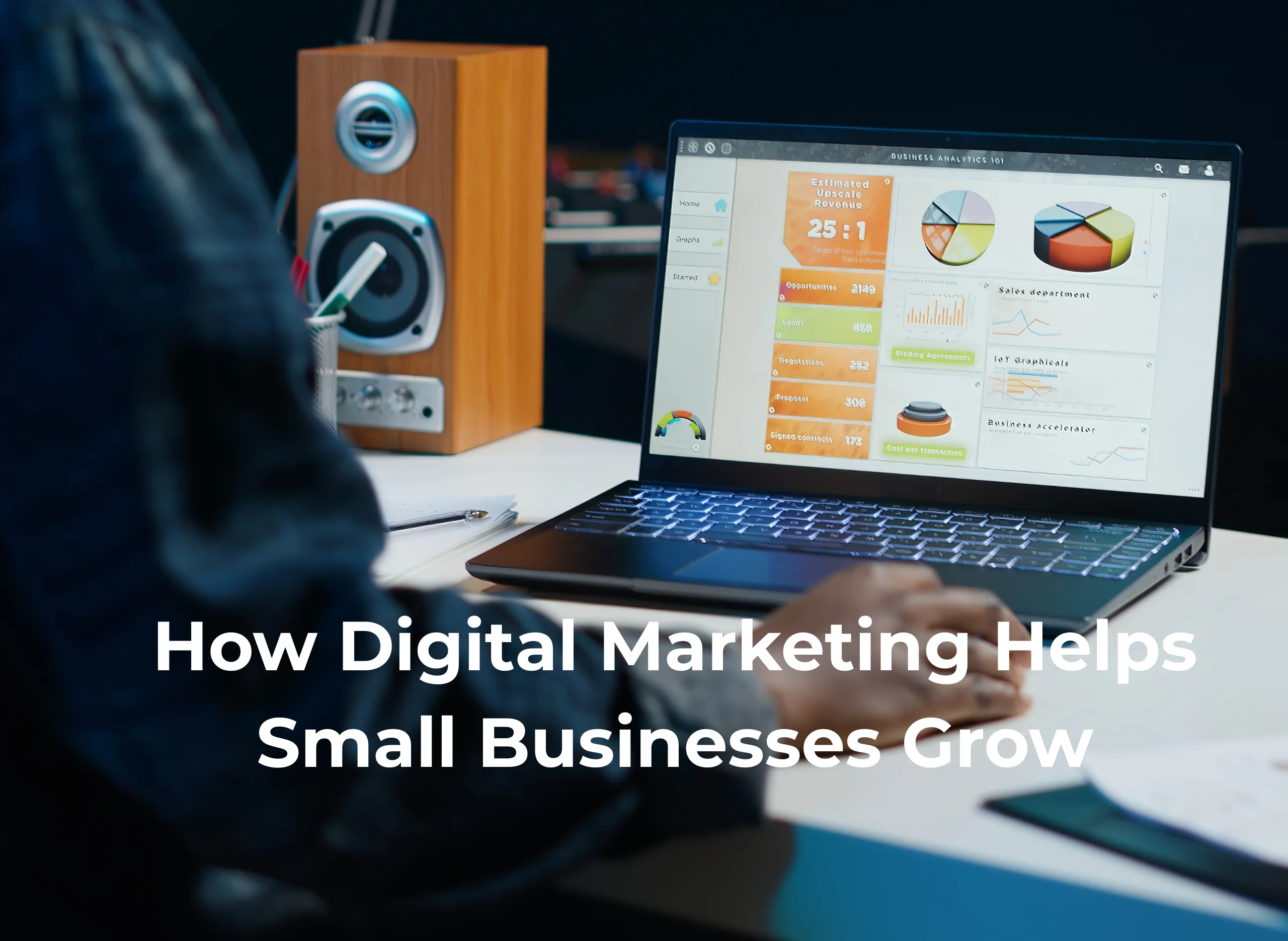
Digital marketing has evolved the way small businesses communicate with their customers, build trust, and drive sales. Traditional marketing is not enough to get established in today’s competitive world. Customers spend more time online searching for products, reading reviews, comparing prices, and interacting with brands via social media and websites. This shift has made digital marketing one of the most powerful tools for small businesses. Small businesses usually have tight budgets, limited staffing levels, and stiff competition from larger companies. Digital marketing offers a solution to these challenges by allowing cost-effective ways to reach targeted audiences. Digital marketing can help businesses grow without needing to spend huge amounts of money. This could be through social media, search engines, email campaigns, content marketing, or online advertising. Digital marketing explained Digital marketing refers to the use of digital technologies and online platforms to promote products or services. It performs: Digital marketing allows businesses to communicate directly with customers and learn what’s they require and give better experiences. Why Digital Marketing Is Essential for Small Businesses For small businesses, visibility, customer trust, and consistent engagement are the keys. Digital marketing offers all these advantages 1. Affordable Marketing Traditional marketing methods like newspaper ads, TV commercials, and billboards can be expensive. Small businesses simply can’t match the big ad budgets. Digital marketing is more affordable because: You can set up social media accounts for free. This means small businesses can compete with large businesses without spending millions. Enhanced Internet visibility The majority of customers check online before they purchase a product or service. If it isn’t online, potential customers may never find a business. Digital marketing increases the visibility through: Google and various other search engines When customers search for relevant keywords, businesses with a strong digital presence rank higher in search results. more efficient Customer Targeting Traditional advertising is a dispersed strategy; it impacts everyone, even those who don’t care. Digital marketing allows businesses to reach the right audience. Developing Brand Awareness “Brand awareness is essential to business growth. Customers like buying products from brands that they are familiar with and trust. Digital marketing develops awareness via: A consistent digital presence makes a business more easily identifiable over time. Social Media Marketing to Grow Your Business Billions of people use social media platforms such as Facebook, Instagram, LinkedIn, Twitter, and YouTube. Social media for small businesses: Social media also enables businesses to respond to customer questions and feedback quickly. Advantages of Social Media Marketing Higher Customer Engagement Customers can like, comment, share, and message directly to businesses.

Information technology (IT) infrastructure is now the foundation of contemporary corporate operations in the fast-paced digital economy. Strong IT infrastructure is necessary for facilitating expansion, improving productivity, improving customer satisfaction, and guaranteeing long-term viability, regardless of the size of the business. In an increasingly highly technologically sophisticated world, companies that make strategic investments in their IT systems are better positioned to innovate, compete, and grow. Comprehending IT Infrastructure The hardware, software, networks, data centers, cloud services, and IT-related services that support the management and operation of enterprise IT environments collectively are referred to as IT infrastructure. In addition to virtual components like cloud computing platforms, cybersecurity systems, and job apps, it also consists of physical components like servers, PCs, routers, and storage devices. A robust IT infrastructure ensures reliable system performance, secure data management, seamless internal communication, and continuous service delivery. Even the most creative ideas for business could find it challenging to flourish without a solid technology base. Increasing the Effectiveness of Operations Increased operational efficiency is one of the main advantages associated with IT infrastructure. Customer relationship management (CRM) software, automation tools, and enterprise resource planning (ERP) systems all aid in simplifying ordinary corporate operations. Data entry, inventory monitoring, and payroll processing are standard tasks that can now be automated to minimize time and eliminate errors. Effective IT systems also enhance communication among departments. Teams can connect in real time, no matter where they are in the world, thanks to cloud-based collaboration technologies. In the age of remote and hybrid work workflows, this is especially essential. Employee productivity rises while operating expenses fall when they have access to dependable systems and quick networks. Supporting Growth and Scalability Growing a business frequently results in higher expectations, namely more clients, more data, and more processes. Organizations may easily adjust to these changes without experiencing significant interruptions thanks to a scalable IT infrastructure. For instance, cloud computing helps firms avoid needless investments in physical hardware by facilitating them to scale resources up or down based on demand. Businesses may enter new markets, introduce new goods, or manage seasonal spikes without jeopardizing performance thanks to scalability. Businesses with malleable IT systems are better able to react to fluctuating the needs of customers and business opportunities. Strengthening Security and Data Management A further essential component is cybersecurity. Businesses need to invest in intrusion detection systems, firewalls, encryption technologies, and frequent security audits as cyber threats become even more complicated. A single data breach may harm customer trust, cause financial losses, and harm a company’s reputation. By putting robust safety protocols and backup procedures in place, a robust IT infrastructure lowers these risks. Organizations can also use data analytics technologies to track performance, analyze patterns, and forecast future results. Businesses may make strategic decisions that foster growth and profitability with precise data insights. Enhancing the Client Experience In the digital age, customer expectations have evolved significantly. Customers demand effortless online interactions, tailored experiences, and quick service. Businesses may use CRM systems, chatbots, mobile apps, and e-commerce platforms to address these requirements, because of IT infrastructure. Websites load quickly, transactions are handled securely, and customer inquiries are quickly answered thanks to robust IT systems. Technical issues or outages can lead to lost business and irate clients. Thus, brand loyalty and consumer satisfaction are directly influenced by investing in high-performance infrastructure. Moreover, businesses can use technology to acquire user input, assess purchasing patterns, and adjust marketing techniques. Customer relationships strengthen and retention rates increase with focused offerings and personalized communication. Enabling Competitive Advantage and Innovation The primary driver in the expansion of businesses is innovation. Corporations can obtain a competitive advantage in the market by implementing cutting-edge technologies like artificial intelligence (AI), machine learning, the Internet of Things (IoT), and big data analytics. But for these technologies to work well, they need a robust and adaptable IT infrastructure. Businesses could develop digital products, test new concepts, and enhance service delivery with the help of contemporary IT systems. For instance, businesses can find market gaps and develop creative solutions with the use of data-driven insights. Initiatives for digital transformation, involving automating processes or putting in place smart manufacturing systems, are only feasible with dependable infrastructure. Organizations that don’t adopt technology rapidly are at the risk of falling behind rivals who use cutting-edge solutions to boost productivity and client engagement. Facilitating Collaboration and Remote Work The necessity of robust IT infrastructure has been brought to light by the global trend toward remote work. Employees can operate efficiently from any location thanks to secure virtual private networks (VPNs), cloud collaboration tools, and communication platforms. While some businesses experienced major disruptions, many who made investments in digital infrastructure were able to adjust with ease. A well-designed IT system facilitates real-time communication, protects data privacy, and guarantees safe access to business resources. In addition to increasing employee satisfaction, this flexibility broadens the talent pool by enabling to recruit skilled workers from different parts of the world. Resource Management and Cost Optimization IT infrastructure can result in long-term cost savings even when it initial expenditures. Cloud computing lowers maintenance expenses and does away with the crucial importance for pricey on-premises gear. Automated systems eliminate errors that could cause financial losses and lower labor costs. Additionally, monitoring systems and predictive maintenance tools assist in discovering any technical problems before they become expensive problems. Instead of debugging regular technical issues, businesses may zero in on strategic goals and allocate resources more efficiently. Ensuring Business Continuity Operations can be interrupted through unforeseen occurrences like cyberattacks, natural calamities, or system breakdowns. Disaster recovery plans, data backups, and redundancy solutions that guarantee company continuity are all components of a complete IT architecture. Geographically dispersed data centers and cloud backups lower the chance of data loss and long outages. Planning for business continuity maintains income sources and retains consumer trust. Businesses that can bounce back from setbacks promptly show resilience and trustworthiness, which improves their standing in the market. Supporting Governance and Compliance Requirements pertaining to information

The way that companies operate has shifted rapidly in the digital world. One of the most crucial drivers of this transformation is the Internet of Things (IoT). The IoT is a network of connected devices that collect, transmit, and evaluate data across the internet. These devices involve sensors, conventional machinery, automobiles, smart appliances, electronic gadgets, and industrial equipment. IoT allows immediate communication among devices, which helps businesses automate processes, improve efficiency, reduce costs, and make smarter decisions. As concurence in industries grows, organizations are looking for innovative ways to streamline operations and provide enhanced customer experiences. IoT is a game-changing technology that allows businesses to monitor operations in real-time, predict problems before they occur, and increase overall productivity. Overview to Business IoT IoT works through a combination of smart devices, cloud computing, sensors, and data analytics. Devices collect information from the environment and transmit it to centralized systems for processing. Then they can take that data and analyze it as well as act on the insights right away.” For example, a manufacturing company may use IoT-enabled sensors to monitor machine performance. If a single one of the machines starts to overheat, the system sends an alarm before a complete breakdown. This avoids costly downtime and improves operational efficiency. The true power of the IoT is its ability to connect physical systems with digital intelligence. Companies can automate tasks and receive valuable insights instantly rather than relying on manual monitoring and traditional processes. Smaller interruptions & Predictive Maintenance Traditional maintenance services usually depend on inspections or replacements after a failure has taken place. You might end up with costly repairs and unexpected downtime. The IoT enables businesses to conduct predictive maintenance, identifying problems early on before they become serious problems. Machine-driven sensors constantly track temperature, vibration, pressure, and performance. If it discovers abnormal patterns, it quickly alerts maintenance teams. Businesses can arrange for repairs before equipment fails. Predictive maintenance is especially helpful in industries such as manufacturing, transportation, and energy. It extends equipment life, minimizes maintenance costs, and reduces production interruptions. For example, airlines use IoT sensors to monitor aircraft components in flight. Engineers receive real-time engine performance updates and can take repairs proactively, improving safety and operational reliability. Enhancing Supply Chain Management A different field where IoT has a great impact is supply chain management. Nowadays supply chains have many stages, including production, shipping, storage, and delivery. IoT improves visibility across the supply chain in real-time tracking and monitoring. Businesses may utilize IoT devices via GPS to track shipments. Managers know the exact location of products and the rough time of delivery. Temperature-sensitive goods like medicines and food products could be continuously monitored to maintain quality standards. With IoT, warehouse management is also improved by automating inventory tracking. Smart shelves equipped with sensors can monitor the amount of stock and alert managers when products need restocking. This reduces delays and increases customer satisfaction. And IoT enables businesses to find bottlenecks in the supply chain. CONCLUSION. IoT offers real-time data exchange among devices, systems, and people, transforming the way business operates in order to become smart. It encourages organizations to become more efficient, save resources, improve customer experiences, and make decisions based on data. IoT offers modern businesses with a world of possibilities, from predictive maintenance and supply chain optimization to personalized services and automation. There are challenges such as security, implementation costs, etc., but if managed well, the benefits of IoT are far greater than the risks. “Companies deploying IoT today will have the competitive advantage and be prepared for the future of digital transformation.” In a world of connectivity and innovation, IoT is a great deal more than just a technology trend. It is becoming an integral part of smarter and more efficient business operations.

Businesses in today’s digital age are driven by technology rather than just money as well as labor. IT infrastructure is essential for supporting operations, boosting output, improving customer experience, and supporting long-term growth for both startups and major businesses. Businesses find it tough to compete, innovate, or scale economically without a solid IT foundation. The collection of hardware, software, networks, data centers, cloud services, and security systems that enable business processes is referred to as IT infrastructure. It serves as the foundation for digital transformation, data management, communication, and service delivery. Strong IT infrastructure continues to grow increasingly more critical as firms depend more and more on digital platforms. 1. Basis for Everyday Activities Technology is essential to any modern business’s day-to-day operations. IT infrastructure is necessary for email, customer databases, billing systems, communication tools, and collaboration platforms. Operations may stop if servers break or networks malfunction, which would lead to lost money and decreased productivity. A robust IT infrastructure provides efficient operations, reduces downtime, and protects employee connectivity. Teams may concentrate on their work without worrying about technical disruptions thanks to dependable advances in technology. By preserving consistency and efficiency, this operational stability promotes the company’s growth. 2. Increasing Efficiency and Productivity Effective IT systems simplify data management, expedite communication, and automate repetitive processes. As an example, remote teams can collaborate simply thanks to solutions that use the cloud. Accounting, inventory control, and customer service generally required less manual labor thanks to automation software. Employees can establish themselves more effectively when they have access to dependable systems, quick networks, and current software. Increased output, quicker service delivery, and more customer satisfaction are all consequences of higher levels of efficiency and are crucial for the expansion of business. 3. Encouraging Scalability Scalability is one of the main benefits of contemporary IT infrastructure. A company’s technology needs grow as it expands. Data, transactions, and communication all increase with the number of clients. This expansion can be managed by a scalable IT system without causing significant disruptions. Here, cloud computing is crucial. Whenever necessary, businesses can expand their storage, processing, and application capacities. Businesses can scale resources up or down in response to demand without making significant investments in physical hardware. Being flexible promotes growth while keeping expenses in control. 4. Analytics and Data Management One of the most vital assets for any company is data. Secure and well-organized data systems serve as vital for customer information, sales reports, financial records, and market insights. Appropriate data backup, storage, and accessibility are assured by IT infrastructure. Businesses may analyze consumer behavior, market trends, and operational performance through the aid of sophisticated analytics technologies. Decision-makers can lower risks and develop better strategies with fixed insights. Businesses that effectively use data frequently acquire a competitive edge in their particular industry. expenses in control. 5. Enhancing the Client Experience Customer experience is a major growth driver in today’s cutthroat industry. IT infrastructure is necessary for responsive customer support systems, secure payment gateways, quick websites, and tailored assistance. Customers may select competitors if a website loads slowly or if payment methods breakdown. Secure transactions, seamless digital interactions, and speedy problem-solving are all secured by a well-designed IT infrastructure. This creates loyalty and trust, each of which is crucial to sustained growth. 6. Increasing Cybersecurity Cybersecurity is becoming ever more important as companies use digital platforms. Phishing scams, ransomware attacks, and data breaches can result in serious financial and reputational harm. Firewalls, encryption, secure networks, and frequent system updates are all components of a robust IT architecture. Putting resources into cybersecurity safeguards private information and increases trust among consumers. Customers are more inclined to interact with the company when they are assured that their information is secure. Reducing legal issues and expensive downtime is an additional benefit of preventing security concerns. 7. Facilitating Digital Transformation and Innovation Growth is fueled by innovation. Companies can obtain an edge over the competition by implementing new technologies like automation, cloud computing, artificial intelligence, and the Internet of Things (IoT). However, a solid IT foundation is crucial for these technologies. Strong infrastructure is necessary for digital transformation projects involving CRM systems, mobile apps, and e-commerce platforms. Corporations with antiquated systems could find it difficult to adopt current technology. Businesses with modern, agile IT environments, on the other hand, are capable of experimenting, innovating, and reacting quickly to changes in the market. 8. Supporting Hybrid and Remote Work The import of IT infrastructure has been further highlighted by the growth of remote and hybrid work practices. These days, video conferencing platforms, cloud collaboration tools, secure VPNs, and remote access systems are crucial features of companies’ operations. Employees can work online without sacrificing security or productivity thanks to a robust IT environment. In addition to increasing employee satisfaction, flexibility like this helps businesses recruit talent from around the world, thereby fostering long-term growth. 9. Resource Management and Cost Optimization Building IT infrastructure may significantly reduce long-term costs, but it does need investment. Cloud services save hardware maintenance costs, automated systems cut labor costs, and effective networks protect against losses from blackouts. Optimal resource use is ensured by careful IT planning. Companies may track consumption patterns, keep an eye on system performance, and spot inefficiencies. IT infrastructure can become a cost-saving asset rather than an expense with the right approach. 10. Market Competitive Advantage Technology sometimes divides successful businesses from failed ones in exceptionally competitive industries. Firms with modern IT systems have the potential to respond fast to changes in the industry, provide better digital experiences, and deliver services quicker. A competitor with ancient infrastructure might experience security flaws, lagging response times, and limited scalability. Businesses that invest in IT infrastructure show themselves as modern, reliable, and customer-focused—qualities that draw in partners and users. Building a Strong IT Infrastructure Strategy Businesses need to have an identified IT strategy in order to maximize business growth. This includes the following: Evaluating the current infrastructure and finding any gaps Acquiring cloud solutions that are scalable Put comprehensive

Businesses will include facing challenges via more dispersed workforces, faster digitization, and higher expectations for efficiency and innovation in 2026. Employing the appropriate technology is fundamental, not only an edge over rivals. Today’s productivity applications are smarter, more collaborative, and more seamlessly interoperable than ever thanks to AI-powered assistants and integrated automation platforms. 1. Smart Automation & AI Assistants 1.1 Generative AI Assistants Workplaces are still changing as a result of the AI revolution. Contemporary AI assistants are capable of far more than just producing words; they can also compose documents, evaluate datasets, summarize meetings, and even propose ways to improve corporate strategies. Capabilities: Quick meeting summaries and the extraction of action items Automated creation of reports Drafting emails with tone optimization Information extraction from business data Use Cases: Automation of customer service Making a sales proposal Internal search for knowledge Useful Advice: Integrate AI assistance into project boards and CRM systems. Use confidential company data to train AI for customized insights. 1.2 Platforms for Intelligent Automation Automation systems are currently crucial for getting rid of monotonous processes, and AI-powered automation has significantly increased in 2026. These platforms monitor processes for optimization, link apps, and initiate operations across systems. Examples of Automated Tasks: Carry the lead in follow-ups and nurturing Generation of receipts and reminders for payment Tracking inventory and replenishment notifications Advantages Huge time savings Minimal human error Faster cycles of customer response 2. Tools for Cooperation and Communication In contemporary business, remote and hybrid work are still commonplace. It is crucial to have tools that facilitate file sharing, collaboration, and workflow transparency. 2.1 Platforms for Unified Communication These platforms integrate threaded discourse, video calls, and chat; however, the 2026 crop also consists of: Translation of languages in real time AI-generated summaries for sentiment detection The Reasons They Are Important Teams may communicate without switching between apps, which minimizes misalignment and context changes. Top Techniques: Standardize communication channels due to their intended use (e.g., announcements vs. project chat). Make use of groups or channels that encourage cross-functional work and collaborative work. 2.2 Cooperative Work Environments Beyond chat, collaborative workspaces provide real-time teamwork on: Spreadsheets and documents Presentations Visual brainstorming tools and whiteboards Important improvements for 2026 include: Continuous co-editing with integrated AI recommendations based on artificial intelligence version tracking with change explanations Integrated task assignment and timelines This establishes a single work surface in place of the patchwork of different tools. 3. Tools for Project Management and Workflow As teams expand, managing responsibilities and resources becomes more challenging. 2026 tools emphasize adaptability, predictability, and clarity. 3.1 Project Platforms Enhanced by AI These solutions integrate predictive insights with conventional project boards: Automated balancing of workloads Predicting delay risk AI task descriptions based on straightforward suggestions Instead of being reactive, this enables managers to remain proactive. Advantages Improved understanding of the health of the project Reduced manual planning Quicker onboarding of new team members 3.2 Trackers of Goals and Outcomes Teams can align work to strategic outcomes and define measurable targets (OKRs/KPIs) with the use of modern technologies. Things to keep an eye on: AI narrative summaries on progress dashboards Visual modeling of cross-team dependencies alerts when results are declining Everyone stays connected to the corporate goals as a result. 4. Tools for Data and Analytics Data in 2026 is predictive and prescriptive in lieu of merely historical. Every team now has access to genuine business intelligence thanks to modern analytics tools. 4.1 Platforms for Self-Service Analytics Without a data scientist, anyone can use these tools to perform queries, construct dashboards, and produce insights. Important characteristics: Natural-language querying (use phrases for creating questions) Visualizations produced automatically Smart anomaly detection Effect: Instead of waiting for monthly reports, teams may respond to actual questions in real time. 4.2 Hubs for Integrated Data Cloud-based data centers centralize instead of dispersed datasets: Metrics for sales and marketing Data on consumer behavior Performance in business Businesses suffer from a single source of truth across platforms with unified access and governance controls. 5. Sales and Customer Experience Tools Productivity tools in 2026 are not only internal; they immediately increase customer value. 5.1 Platforms for Customer Engagement These platforms integrate interactions with customers through several channels, including social media, email, web chat, and support. AI currently assists with: Resolution of predictive support Subject routing in real time The study of sentiment This results in pleased customers and quicker response times. 5.2 Contemporary CRMs (Customer Relationship Management) CRMs have changed as a result of AI improvements: Astute lead scoring Automated tips for follow-up Warnings about potential health risks Instead of focusing on data entry, sales teams might zero in on closing. Conclusion By 2026, productivity tools will have moved from task management to strategic impact and intelligent action. The most effective technologies blend data-driven insights, integrated workflows, collaborative workspaces, and AI assistance, while balancing security and user experience. These approaches empower companies to work more productively, preserve unity, and unlock business growth in a competitive digital space when thoughtfully chosen and implemented.

Technology has always fueled business transformation. Every innovation wave, from the development of computers and the internet to cloud computing and mobile apps, has changed how businesses function and compete. The future of corporate technology promises even more disruption and potential as we enter the digital era. Businesses that quickly adapt will thrive, while those that resist change risk lagging behind. In this blog, we examine the key technological developments that will shape business in the future and what business can anticipate in the years to come. 1. The Mainstreaming of Artificial Intelligence AI is now not merely a futuristic idea. It is already incorporated into regular business processes, and its impact will only grow. Businesses are using AI-powered tools to analyze large datasets, automate repetitive operations, and make more intelligent choices. AI will eventually transcend automation and develop into a strategic ally. Businesses will be able to more precisely predict demand with the use of analytics for prediction. Chatbots powered by AI will offer individualized client support around-the-clock. Effective machine learning algorithms can improve marketing campaigns, optimize supply chains, and spot fraud. Software development, product design, and content creation will all be transformed by generative AI tools. AI assistants will be used by businesses to produce reports, presentations, and even code, greatly boosting productivity. But businesses also need to concentrate. 2. Cloud and Hybrid Infrastructure’s Ascent Business IT infrastructure has already undergone a transformation thanks to cloud computing. Through cloud service providers, businesses can use scalable resources in place of costly on-premise servers. Multi-cloud and hybrid techniques will be the norm in the future. Businesses can combine private and public cloud systems with hybrid cloud models, which offers flexibility, enhanced performance, and better security control. Multi-cloud tactics convey company continuity and prevent vendor lock-in. Data processing will take place closer to the point of data generation as edge computing advances. For sectors like manufacturing, healthcare, and logistics, this will lower latency and boost performance. Faster and more effective digital ecosystems will result from the convergence of cloud and edge computing. 3. Making Decisions Based on Data Data is frequently referred to as the “new oil,” and its worth will only rise. Every day, businesses produce massive volumes of data about anything from sales transactions and IoT devices to customer interactions and social media engagement. Advanced analytics tools that transform unprocessed data into useful insights will be the main emphasis of future business technology. Leaders will be able to make choices more quickly and accurately with the aid of real-time dashboards and AI-powered analytics tools. To keep sensitive data, businesses will increase their investments in data governance and compliance. Data privacy laws are getting more stringent, and companies need to make sure that customer data is handled ethically and transparently. Businesses that successfully use data while upholding trust will have a significant competitive edge. 4. Prioritizing cybersecurity Cyber threats are more complex as technology develops. The number and complexity of ransomware attacks, phishing schemes, and data breaches are rising. Cybersecurity will become a major business focus in the future rather than merely an IT problem. Companies will implement zero-trust security models, in which each request for access is investigated before authorization is granted. Security systems with artificial intelligence (AI) abilities will recognize anomalous activity and react to threats promptly. Another crucial component of cybersecurity will be employee training. One of the greatest hazards is still error by humans. Businesses will spend money on awareness campaigns and more robust authentication techniques like multi-factor authentication and biometric verification. 5. Robotic Process Automation (RPA) and Automation Workplace productivity will be changed by automation. Data entry, invoice processing, and payroll management are examples of repetitive, rule-based operations that can be handled by robotic process automation (RPA) solutions. Automation will grow deeper and flexible in the future. AI, machine learning, and RPA together will create hyperautomation, which will optimize whole business processes from the very start to the very end. Automation will free up workers to concentrate on higher-value work like strategy, innovation, and customer interaction rather than replacing them. Businesses that properly incorporate automation will boost accuracy, cut spending, and increase efficiency. 6. The Development of Hybrid and Remote Work Workplace culture has been forever altered by the global trend toward remote employment. Teams may now operate remotely thanks to cloud-based software, video conferencing networks, and digital collaboration tools. Hybrid work models will be prevalent in the future. Businesses will spend money on AI-powered productivity tools, virtual collaboration platforms, and safe digital workspaces. Immersion meeting experiences may be generated using technologies like augmented reality (AR) and virtual reality (VR). Digital team-building activities, virtual training sessions, and remote onboarding will all advance in complexity In addition, businesses need to give preference to digital work-life balance and employee well-being. Technology will be vital in tracking output while boosting agility and engagement. The Development of Hybrid and Remote Work Workplace culture has been forever altered by the global trend toward remote employment. Teams may now operate remotely thanks to cloud-based software, video conferencing networks, and digital collaboration tools. Hybrid work models will be prevalent in the future. Businesses will spend money on AI-powered productivity tools, virtual collaboration platforms, and safe digital workspaces. Immersion meeting experiences may be generated using technologies like augmented reality (AR) and virtual reality (VR). Digital team-building activities, virtual training sessions, and remote onboarding will all advance in complexity. 7. Smart operations with the Internet of Things (IoT)Physical devices can gather and share data by connecting to the internet through the Internet of Things (IoT). Real-time operational insights are provided by smart sensors in factories, warehouses, and stores for sale. Logistics firms will keep an eye on shipments in real time.IoT will generate fully integrated smart operations when linked with cloud computing and AI. Corporations will run better operations, cut waste, and enhance customer satisfaction. 8. Green technology and sustainability Around the world, businesses are starting to prioritize sustainability. Investors and consumers want companies to use eco-friendly methods and lessen their influence on

